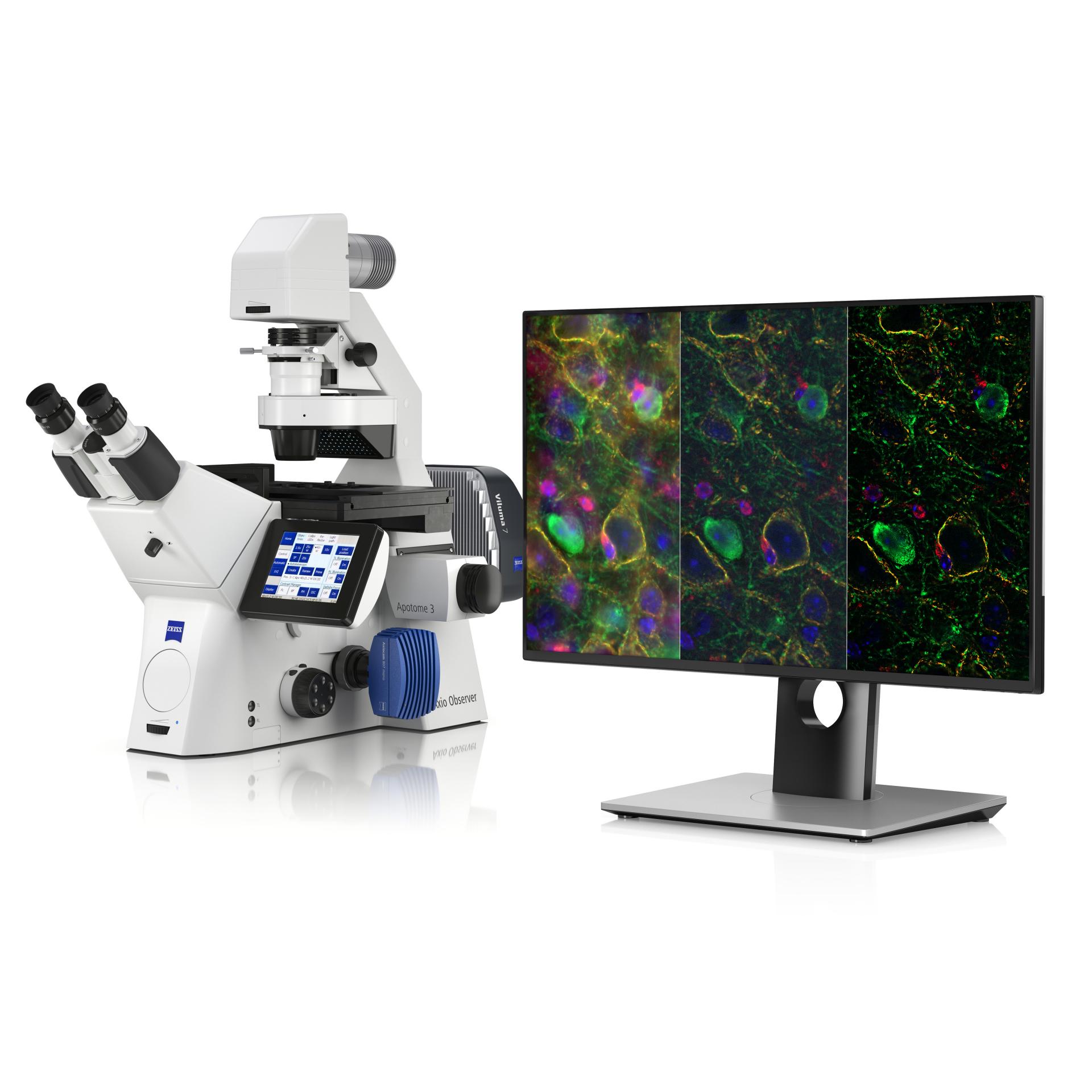
ZEISS Apotome 3 with Axio Observer

ZEISS Apotome Plus Precision Redefined in Fluorescence Microscopy

Experience confocal-like image quality with your widefield microscope—unleash the power of optical sectioning down to 180 nm.

  • Confocal-like quality: Lateral resolution down to 180 nm for unmatched detail.
  • Optimized workflows: Process data while capturing images with smart Direct Processing.
  • Enhanced signal-to-noise ratio: Superior image clarity even for low-signal samples.

ZEISS Apotome 3 with Apotome Plus

See How It Works
  • See the Technology in Action

    Apotome Plus employs structured illumination to remove out-of-focus light, combining hardware precision with advanced image processing to deliver crisp, reliable data.
Cos7 cells (nuclei stained with Hoechst, tubulin with Alexa 488 and Phalloidin with Alexa 568) imaged with Plan Apochromat 63x/1.4.

Reliable Optical Sections

Under Varying Experimental Conditions

Apotome 3 significantly increases the axial resolution compared to conventional fluorescence widefield microscopy: You obtain optical sections that allow 3D rendering, even from thick specimens. Three grids of different geometries give you the best resolution for each objective. You can focus on your experiment as the ideal illumination structure is automatically selected, always resulting in high-contrast optical sections.


Caption: Cos7 cells (nuclei stained with Hoechst, tubulin with Alexa 488 and Phalloidin with Alexa 568) imaged with Plan Apochromat 63x/1.4.

Cortical neurons (left: Widefield; right: Apotome 3). Courtesy of L. Behrendt, Leibniz-Institute on Aging – Fritz-Lipmann-Institut e.V. (FLI), Germany.

Peer-reviewed Algorithms

Linear Approaches for True Optical Sections

Purely software-based methods require either prior knowledge of the sample (AI based methods) or rely on complex algorithms that have not been peer-reviewed. Users must trust that these black-box solutions do not falsify information when “enhancing” the image. ZEISS Apotome 3 uses the information from the structured illumination combined with documented algorithms to create a crisp optical section you can trust.

Caption: Cortical neurons (left: Widefield; right: Apotome 3). Courtesy of L. Behrendt, Leibniz-Institute on Aging – Fritz-Lipmann-Institut e.V. (FLI), Germany.

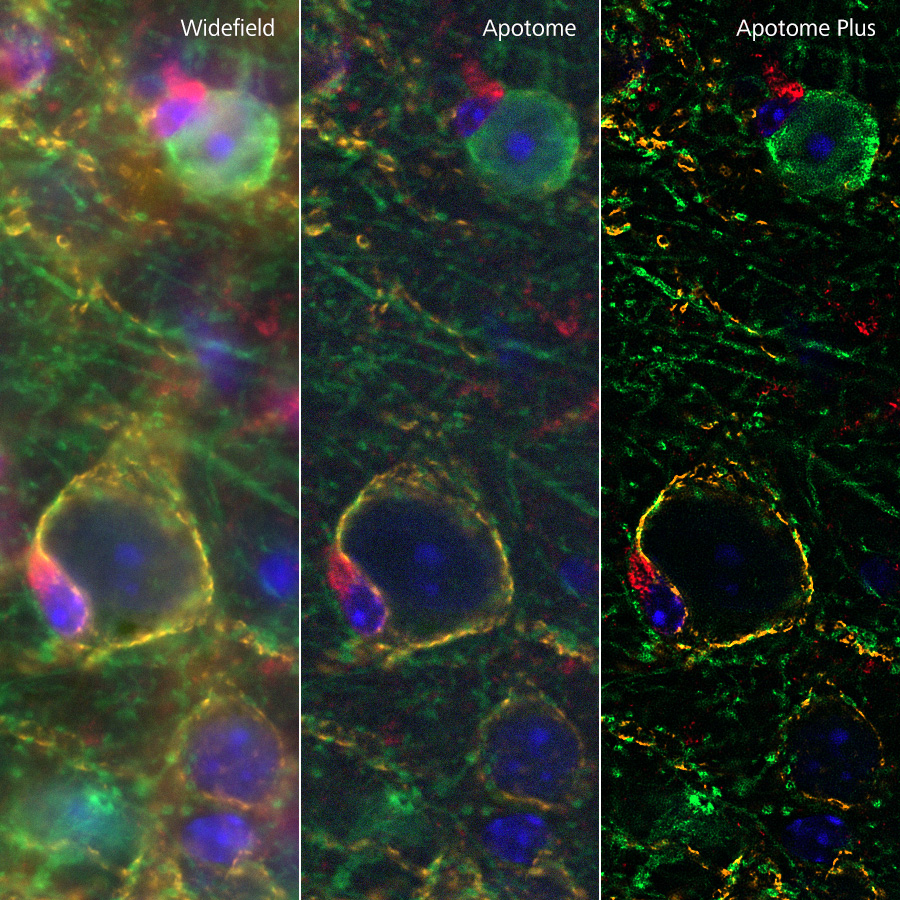
35 μm sagittal section of adult mouse brain, imaged with ZEISS Axio Observer and ZEISS Apotome, processed with Apotome Plus. Sample courtesy of University of California, Davis / NIH NeuroMab Facility.
Sagittal Section of Adult Mouse Brain

 Sample courtesy of University of California, Davis / NIH NeuroMab Facility.
Sample courtesy of University of California, Davis / NIH NeuroMab Facility.

Confocal-like Image Quality

180 nm Resolution with Apotome Plus

Resolve details that were not visible before with your widefield microscope: With Apotome Plus, you can obtain structural information at lateral resolution down to 180 nm. The combination of structured illumination with state-of-the-art image processing substantially improves the signal-to-noise ratio and resolution in x, y, and z.

Caption: 35 μm sagittal section of adult mouse brain, imaged with ZEISS Axio Observer and ZEISS Apotome, processed with Apotome Plus. Sample courtesy of University of California, Davis / NIH NeuroMab Facility.

Free Choice of Light Source and Dyes

Free Choice of Light Source and Dyes

It’s Your Decision, Not the Technology’s

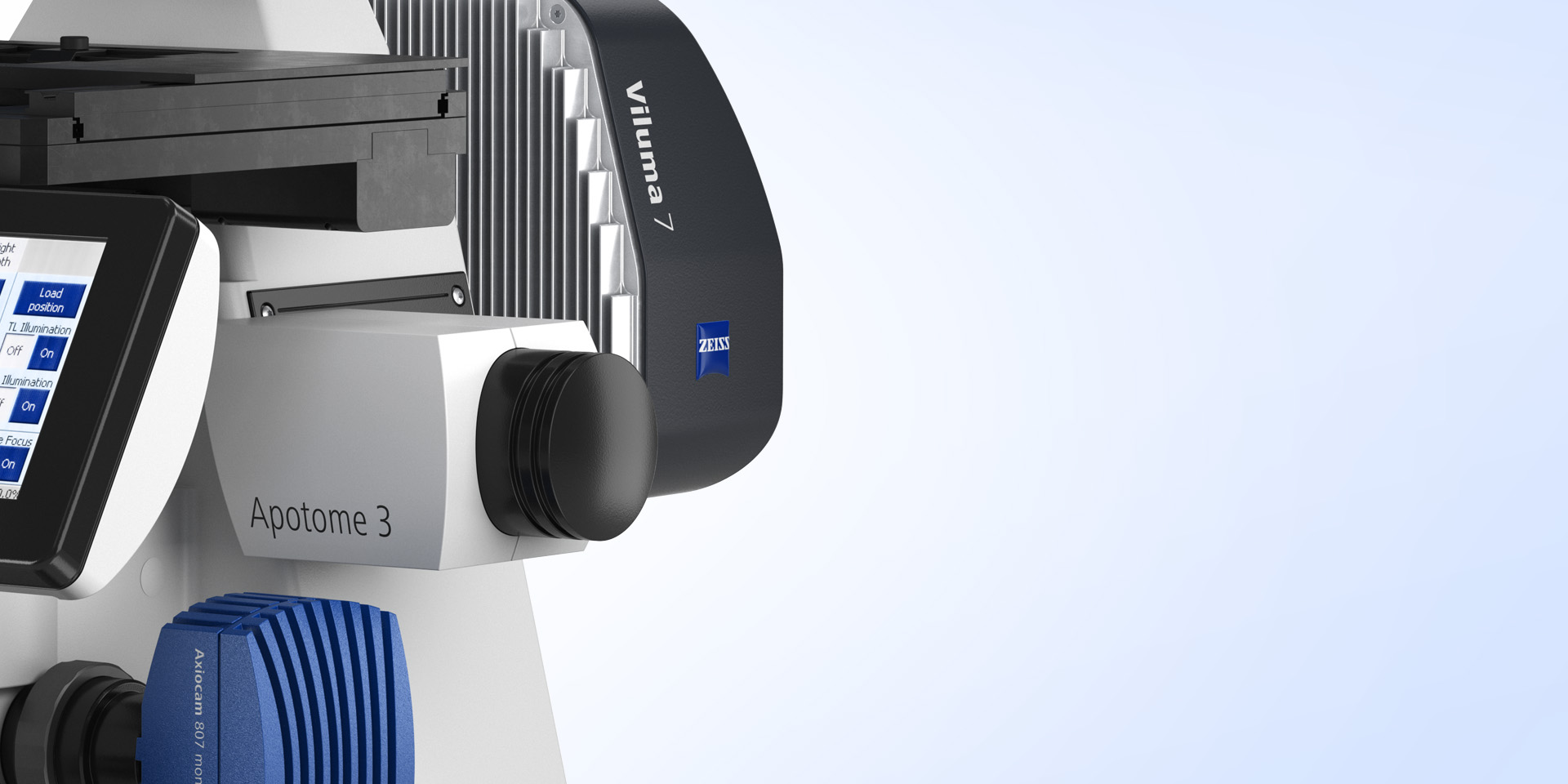
Your experiments often evolve in complexity and requirements. That’s why you need adaptable equipment. Use Apotome 3 with metal halide lamps, economic white light LEDs, or a gentle, multi-color LED light source of the ZEISS Viluma illumination system. Whether you work with DAPI, Alexa488, Rhodamin, Cy5, or with vital dyes such as GFP or mCherry – Apotome 3 adapts to your fluorophores and light source, creating the sharp and brilliant images you expect.

A: Widefield image. B – D: Raw images acquired with different grid positions. E: Resulting image; out-of-focus light is efficiently removed by the structured illumination.

A: Widefield image. B – D: Raw images acquired with different grid positions. E: Resulting image; out-of-focus light is efficiently removed by the structured illumination.

A: Widefield image. B – D: Raw images acquired with different grid positions. E: Resulting image; out-of-focus light is efficiently removed by the structured illumination.

The Apotome 3 Operation Principle

Apotome 3 uses a grid to generate a pattern of intensity differences. If out-of-focus light is present at a certain region of the sample, the grid becomes invisible. After the fluorescence of a grid position is acquired, the grid moves to the next position. A true optical section with higher contrast and resolution is calculated.

ZEISS Apotome 3 at Work

  • Cortical neurons stained for DNA, microtubules and microtubule-associated proteins.

    Cortical neurons stained for DNA, microtubules and microtubule-associated proteins. Courtesy of L. Behrendt, Leibniz-Institute on Aging – Fritz-Lipmann-Institut e.V. (FLI), Germany.

  • Transgenic zebrafish larvae at 4 days post fertilization staining for: Glial fibrillary acidic protein, acetylated Tubulin, GFP and DNA. Embedded in 1.2% low melt agarose.

    Transgenic zebrafish larvae at 4 days post fertilization staining for: Glial fibrillary acidic protein, acetylated Tubulin, GFP and DNA. Embedded in 1.2% low melt agarose. Courtesy of H. Reuter, Leibniz-Institute on Aging – Fritz-Lipmann-Institut e.V. (FLI), Germany.

  • Sagittal section of adult mouse brain, imaged with ZEISS Axio Observer and ZEISS Apotome, processed with Apotome Plus.

    Sagittal section of adult mouse brain, imaged with ZEISS Axio Observer and ZEISS Apotome, processed with Apotome Plus. Sample courtesy of University of California, Davis / NIH NeuroMab Facility.

  • Bovine pulmonal arterial endothelial (BPAE) cells having nuclei stained with DAPI, F-actin with Alexa 488 phalloidin and mitochondria with MitoTracker Red CMXRos. Compared to the widefield image, Apotome removes out of focus light creating a crisp optical section. Apotome Plus further improves image quality and resolution resolving even finer structures.

    Bovine pulmonal arterial endothelial (BPAE) cells having nuclei stained with DAPI, F-actin with Alexa 488 phalloidin and mitochondria with MitoTracker Red CMXRos. Compared to the widefield image, Apotome removes out of focus light creating a crisp optical section. Apotome Plus further improves image quality and resolution resolving even finer structures.

Ready to Revolutionize Your Research?

Schedule a Personalized Demo

Form is loading...